

Close proximity to major industrial zones and Tehran’s logistics & distribution centers.

15–20% lower transport costs compared to road transport.

Lower risk of accidents, damage, and cargo loss.

Bandar Abbas to APRIN in just 48 hours — vs. up to 9 days by road.

Skip long port delays with faster, direct rail handling.

All-in-one services: container handling, storage, stuffing/stripping, and customs clearance.

Store at APRIN and distribute directly across nearby markets.

Rail transport generates lower carbon emissions than road and air travel, making it a more sustainable choice.
As global supply chains increasingly demand faster, more reliable, and cost-efficient transportation solutions, APRIN Dry Port (ADP) has emerged as one of Iran’s most important logistics hubs. Combining a strategic location, advanced infrastructure, multimodal connectivity, and integrated logistics services, ADP provides a comprehensive platform for facilitating domestic and international trade.
With a population of nearly 90 million people and one of the largest economies in the Middle East, Iran serves as a natural bridge between Asia, Europe, and the Middle East. The country's strategic geographic location, combined with ongoing investments in transportation infrastructure, creates exceptional opportunities for regional and international trade.
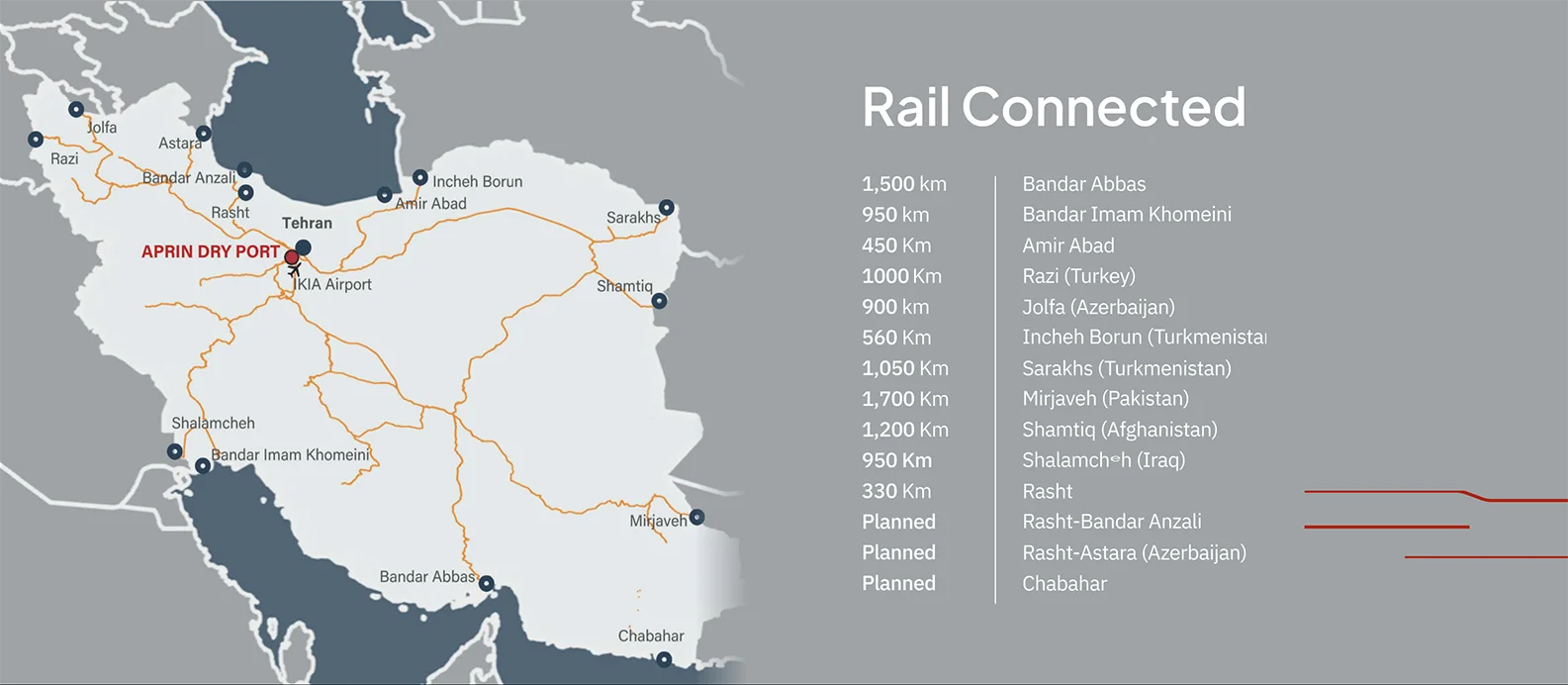
Iran’s rail connections to Turkey, Turkmenistan, Afghanistan, and Pakistan, along with expanding routes to Iraq and Azerbaijan, are playing a crucial role in transforming the country into a major regional logistics and transit hub. At the center of this growing transportation network stands APRIN Dry Port (ADP), serving as a key inland logistics terminal and a critical gateway connecting national and international freight corridors.
ADP is directly connected to major international trade routes, including the International North-South Transport Corridor (INSTC), TRACECA, the Southern Silk Road, and the ECO Transport Corridors. This connectivity provides seamless access to regional and global markets through a single logistics gateway.
Located near Tehran, Iran’s economic and commercial center, ADP offers direct access to the country's largest concentration of consumers, industrial zones, manufacturing facilities, distribution centers, and logistics operators.
Its proximity to key production and consumption centers helps reduce transportation distances, shorten delivery times, optimize supply chain performance, and lower overall logistics costs for importers, exporters, shipping lines, and freight forwarders.
More than just a rail terminal or container yard, APRIN Dry Port functions as a fully integrated logistics ecosystem. By bringing together all essential logistics services within a single location, ADP enables customers to streamline operations, improve efficiency, and reduce operational complexity.
Developed according to international logistics standards, ADP is equipped with modern facilities capable of supporting growing trade volumes and future expansion requirements.
One of ADP’s key competitive advantages is its ability to leverage rail transportation to reduce transit times and improve supply chain reliability across regional and international trade routes.
These competitive transit times position ADP as a strategic cargo consolidation and distribution hub within the growing Eurasian logistics network.
Rail transportation offers substantial economic and environmental advantages compared to long-haul road transport. Through rail-based logistics solutions, ADP helps customers achieve:
With the successful completion of Phase One development and the arrival of the first direct freight train from China to Iran via APRIN, ADP has entered a new phase of operational growth and international connectivity.
Today, APRIN Dry Port (ADP) represents far more than an inland terminal. It is a strategic logistics platform designed to support the future of trade, transportation, and regional connectivity. Through continuous infrastructure development, expanding international partnerships, and growing rail connectivity, ADP is positioned to become Iran’s leading inland logistics hub and one of the most important trade gateways across the Eurasian region.



 English