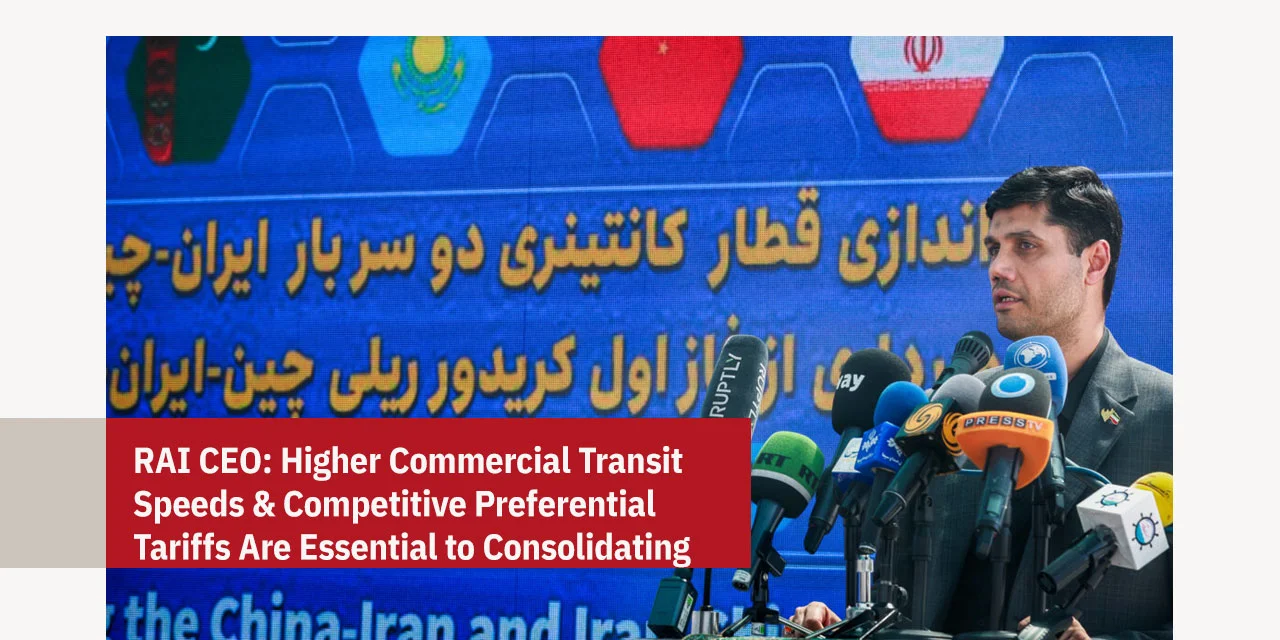
Seyed Miad Salehi, CEO of the Islamic Republic of Iran Railways (RAI), stated that increasing commercial transit speeds and establishing competitive preferential tariff rates among countries along the route are key factors in consolidating the Iran–China rail corridor.
Speaking to reporters during the launch ceremony of the Iran–China Round-Trip Container Train Service at APRIN Dry Port, Salehi noted that operating the service with loaded trains in both directions significantly reduces transportation costs and helps establish the route as a sustainable and competitive international rail corridor.
He emphasized that the corridor will facilitate greater trade flows between China, Kazakhstan, Turkmenistan, and Iran, while providing a faster and secure alternative to maritime transport for many types of cargo. According to Salehi, shipments that traditionally require lengthy transit times by sea can now be transported more efficiently via rail.
The Deputy Minister of Roads and Urban Development added that the expected transit time between Iran and China could be reduced to approximately one-third of current transport times.
Salehi stressed that one of the most important requirements for maintaining regular train operations and ensuring the long-term success of the corridor is the continuous improvement of commercial transit speed. He noted that freight trains must be able to move more efficiently across the entire route.
He added that rail operations within Iran already benefit from relatively high operating speeds and that agreements reached among the participating countries have resolved many operational challenges, paving the way for faster and more reliable train services.
The RAI CEO further emphasized the importance of implementing preferential tariff agreements among the four participating countries, making rail transport more attractive and cost-effective for cargo owners and logistics operators.
According to Salehi, the first trains are transporting automotive components from China to Iran, while mineral products are being exported from Iran to China. He expressed confidence that as the corridor continues to develop, exporters and importers of other commodities will increasingly choose this secure rail route.
Salehi stated that the initial objective is to transport approximately one million tons of cargo annually between Iran and China by rail. He added that this volume could increase substantially as train frequencies rise and commercial transit performance continues to improve.
He also highlighted recent achievements in international rail freight transportation. Last year, for the first time in Iran’s history, potash shipments from Russia were successfully transited through the North–South Transport Corridor to Bandar Abbas. In addition, during June and July of this year, coal shipments were transported entirely by rail from Russia to Bandar Abbas.
According to Salehi, both operations received positive feedback from Russian partners due to their high transit speeds and the implementation of uniform preferential tariff arrangements among the participating countries. He noted that the head of Russian Railways formally expressed appreciation for Iran’s role in facilitating these successful transit operations.
The continued development of the Iran–China rail corridor is expected to strengthen regional connectivity, support international trade growth, and further position Iran as a strategic logistics bridge between Asia and Europe.
Source: IRNA News



 English