In 2026, geopolitical developments, increasing risks across traditional maritime routes, and ongoing disruptions affecting global supply chains have encouraged many importers to reassess how they move cargo from China to Iran. Concerns over congestion, rising transportation costs, and uncertainties surrounding key maritime corridors have accelerated interest in alternative transport solutions that offer greater reliability, speed, and predictability.
Against this backdrop, the China–Iran rail corridor has emerged as one of the most important trade routes in Eurasia. The growing connectivity between China's manufacturing centers and APRIN Dry Port (ADP), Iran’s first rail-based container dry port and a leading Integrated Logistics Hub, is creating new opportunities for businesses seeking more efficient access to the Iranian market.
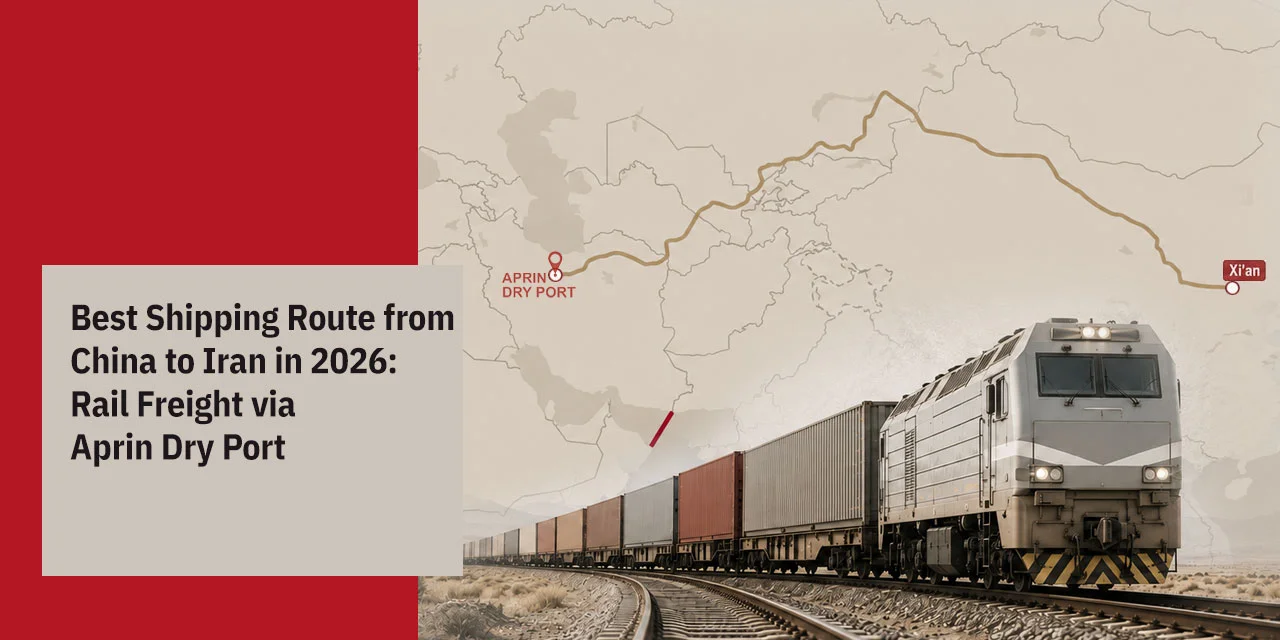
The rail route connecting China and Iran begins in major Chinese logistics and manufacturing centers such as Xi’an and passes through Central Asia before reaching Iran. The corridor connects directly to APRIN Dry Port, strategically located southwest of Tehran at the crossroads of Iran’s railway network.
This route has become an increasingly important component of Eurasian trade, linking China with Iran, the Middle East, Central Asia, and European markets. As international businesses seek to diversify transportation options and reduce dependence on maritime routes, rail freight continues to gain momentum as a reliable and resilient alternative.
One of the most significant advantages of rail transportation is speed. While ocean freight from China to Iran typically requires between 30 and 45 days depending on shipping schedules, port congestion, and route conditions, direct rail freight services can reduce transit times to approximately 13 to 16 days.
APRIN Dry Port has established itself as a key destination within this corridor, with cargo moving from Xi’an to APRIN in as little as 13 days. This reduction in transit time allows importers to improve inventory management, accelerate product availability, and create more agile supply chains.
Rail freight offers a practical balance between cost and speed. While sea freight may remain the lowest-cost option for certain high-volume, low-value commodities, it is increasingly exposed to delays, congestion, and geopolitical uncertainties. Air freight, on the other hand, provides rapid delivery but often comes at a significantly higher cost.
For many categories of cargo—including industrial equipment, automotive parts, consumer goods, electronics, machinery, and higher-value products—rail transportation provides an attractive middle ground. Importers benefit from faster delivery than ocean freight while maintaining transportation costs substantially lower than air cargo.
The China–Iran rail corridor supports both FCL (Full Container Load) and LCL (Less than Container Load) shipments, offering flexibility for businesses of all sizes.
FCL services allow importers to utilize an entire container for a single shipment, making them ideal for large cargo volumes and high-frequency imports. LCL solutions enable multiple shipments from different customers to be consolidated within a single container, creating a cost-effective option for businesses with smaller cargo volumes or regular procurement requirements.
This flexibility allows companies to optimize transportation costs while maintaining efficient access to Chinese suppliers and manufacturing centers.
As rail connectivity between China and Iran continues to expand, APRIN Dry Port has become one of the country's most important logistics gateways for imported cargo.
As a customs-bonded multimodal logistics terminal, APRIN provides a comprehensive range of logistics services within a single location. Importers can benefit from container handling, bonded storage, customs clearance, container stuffing and stripping, empty container depot services, container maintenance, temperature-controlled storage, and value-added logistics solutions.
With an annual inbound capacity of 200,000 TEU, dedicated rail infrastructure, on-site customs facilities, cold chain capabilities, container yards, and warehousing services, APRIN is uniquely positioned to support the growing volume of rail freight arriving from China.
One of APRIN’s greatest advantages is its strategic location near Tehran, Iran’s largest industrial and consumer market. Once cargo arrives at APRIN, goods can be efficiently distributed throughout the country using integrated rail and road transportation networks.
Businesses can quickly reach major markets including Tehran, Karaj, Isfahan, Mashhad, Tabriz, Shiraz, Ahvaz, and other key commercial and industrial centers. This capability reduces inland transportation costs, shortens delivery times, and improves overall supply chain performance.
Rather than serving solely as a transportation terminal, APRIN functions as a fully integrated logistics hub connecting international trade corridors with domestic distribution networks.
Recent geopolitical developments have highlighted the importance of transportation diversification. Global businesses increasingly recognize the risks associated with relying on a single transportation mode or route. As a result, governments, logistics providers, and multinational companies are investing heavily in rail-based trade corridors across Eurasia.
Industry reports indicate significant growth in rail freight volumes between China and Iran over the past two years, reflecting increased demand for reliable overland transportation solutions. The China–Iran rail corridor is no longer viewed as an alternative route; it is rapidly becoming one of the primary trade arteries connecting East Asia with the Middle East and beyond.
In 2026, rail freight from China to Iran has emerged as one of the most efficient, secure, and reliable transportation solutions available to importers. With transit times as low as 13 days, support for both FCL and LCL shipments, and reduced exposure to maritime disruptions, rail transportation offers a compelling alternative for businesses seeking greater supply chain resilience.
At the center of this growing corridor stands APRIN Dry Port (ADP), Iran’s first rail-based container dry port and a leading Integrated Logistics Hub. By combining rail connectivity, customs services, warehousing, container operations, and nationwide distribution capabilities, APRIN enables businesses to efficiently move cargo from China to markets across Iran.
For companies looking to optimize import operations, reduce transit times, and strengthen supply chain performance, APRIN Dry Port is increasingly becoming the preferred gateway for China–Iran trade.



 English